The African Ancestry & Reconnection Guide
Your story did not begin with the last chapter.
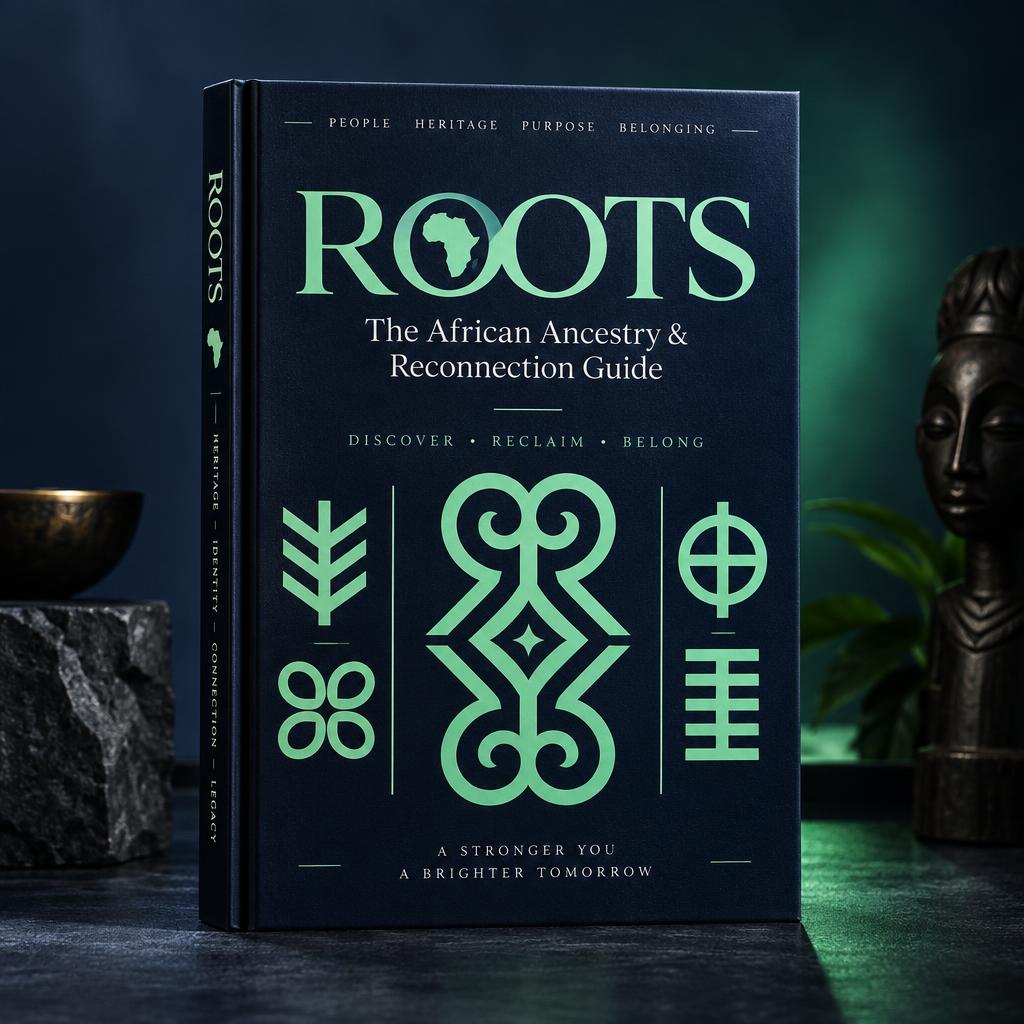
You know where you were born. But do you know where your story began? ROOTS is a practical guide to family history, genealogy, DNA, African regions and meaningful reconnection.
- 10
- Chapters
- 7+
- Workbook sheets
- 30
- Day journey
The central idea
Your roots are not a single answer. They are a story you can investigate.
The answer is rarely a single country, a single ethnicity or a single DNA percentage. It is a trail of names, places, family memories, records, migrations and stories that become clearer when you put them together. ROOTS does not replace the identity you built — it gives you the tools to investigate the history that came before you.
A note before you begin
Ancestry research produces clues, probabilities and family connections. Not every question has a neat answer. Protect your privacy and verify legal information with the current official source.
Inside ROOTS
A journey from question to connection.
Ten chapters that move you from a quiet question to documented evidence, real context and a reconnection that lasts beyond a single trip.
The Question
Why the search matters
The Interruption
History, displacement and lost links
Start With What You Know
Family memory before databases
Follow the Records
Documents turn stories into evidence
DNA, Properly Understood
A clue, not a final answer
Africa Is Not One Place
Regions, peoples and histories
The Benin Example
A modern pathway worth understanding
What Does Returning Mean?
From tourism to relationship
Your 30 Day Roots Journey
Four weeks of practical action
Your Ancestral Profile
A living record of what you discover
The method
Build links, not legends.
Search
Collect names, dates, places, stories and clues — starting with the people who still remember, long before any database.
Verify
Separate family memory from documented evidence. Move backward one generation at a time, one source at a time.
Connect
Turn evidence into relationship: historical context, community, and a meaningful next step instead of a fantasy.
The evidence ladder
A serious ancestry project does not begin by choosing the country you hope is yours. It climbs one rung at a time.
- 01
Known person
Start with what you can document.
- 02
Known place
Confirm where that person lived.
- 03
Known relationship
Connect parent to child, then child to parent.
- 04
Earlier record
Use the strongest available source.
- 05
New hypothesis
Only then decide what deserves deeper research.
Rule of thumb
If a claim cannot be traced to a source, label it a clue — not a fact.
DNA, properly understood
An ethnicity estimate is a clue, not a final answer. DNA can help answer who might be connected — it does not automatically answer who you are. ROOTS shows you how to read your result like an investigator, combined with records and family trees.
The 30 day roots journey
Four weeks. One story. Start today.
Week 1
Know your family
Interview relatives. Gather names, photos, dates and stories.
Week 2
Follow the records
Search documents. Build one verified family line backward.
Week 3
Understand your ancestry
Learn what DNA can and cannot tell you. Organize matches and clues.
Week 4
Reconnect
Study the places your evidence points toward. Choose one meaningful next action.
A small step each day leads to better evidence, deeper understanding and a story you can pass forward.
Principles from the guide
Ideas you will carry long after the last page.
Do not search for a stereotype. Search for a person.
Ask your family first. One elder may hold the clue that unlocks the next generation.
A trip can open a door. Reconnection is a practice, not a finish line.
Your research becomes someone else's inheritance.
Begin the search
Start with one name. Follow one clue. Ask one more question.
ROOTS — Visual Edition is a practical guide to family history, genealogy, DNA and meaningful reconnection. Get your copy and turn curiosity into a meaningful next step.
Secure payment via PayPal
Your research becomes someone else’s inheritance.